Rolling demand: catching one spike before it cost 12 months of charges
Under a rolling demand tariff, one high-demand interval can set the demand charge on every bill for a year or more. Here is how one real spike was caught and credited, and how to check your own invoices for it.
- Under a rolling demand tariff, one high-demand interval can set the demand charge for a year or more.
- A real spike passes invoice validation. Finding it means checking at least 13 months of invoices and interval data.
- Summer peaks set a year of charges on some tariffs, and winter heating peaks can do the same.
- One-off spikes can sometimes be excluded, and demand reset after a permanent change, with evidence.
A rolling demand charge is a network demand charge based on a site's highest demand over a rolling period, usually the previous 12 months, rather than only the month being billed. A single high-demand interval can therefore stay on every bill until it leaves that period, unless it is excluded or the demand is reset.
One Wednesday morning in October 2025, a metering technician was on site at a Melbourne hotel. For one 15-minute interval, the hotel's demand jumped above 1,100 kVA, more than double its usual peak.
The spike was over within minutes, and nobody on site noticed. On a tariff that measures demand month by month, it would have set October's demand charge and then dropped away.
The hotel was on a rolling demand tariff. Left on its bills, that one spike would have cost more than $100,000 over the next 12 months.
How does a rolling demand charge work?
Rolling demand is one of several ways a demand charge can be calculated. Under a rolling demand tariff, the demand charge for each month is based on the highest demand recorded over a rolling period, usually the previous 12 months, rather than just the month being billed. This means a single high-demand event can affect your bills for a year or more. CitiPower and Powercor, for example, apply a rolling demand charge on their large business tariffs (low voltage, high voltage and sub-transmission). It is based on the maximum 15-minute kVA demand recorded between 7am and 7pm on workdays over the prior 12 months.
On other tariffs, the demand calculation is refreshed each month. Ergon Energy Retail's monthly demand tariffs for large businesses in regional Queensland (Tariffs 44A, 50B and 50C), for example, measure demand over 30-minute periods and reset it each billing cycle.
Rolling charges reflect how networks are built. Networks size their infrastructure to meet a site's maximum demand, and that capacity has to be available whether the peak happens every day or only once. Under a rolling tariff, a site keeps paying for the capacity its peak used until the peak drops out of the rolling period or the network resets it. The aim is to encourage sites to manage and reduce their peak demand permanently.
How was one spike caught before it cost a year of charges?
The technician's visit caused the spike, and Eutility's daily demand alert picked it up. The hotel's demand had jumped by more than 700 kVA. It usually peaks below 500 kVA.
The hotel was on one of CitiPower's large low voltage tariffs, and the spike fell inside the hours its rolling demand charge counts. From that month on, the charge was billed on that peak instead of the roughly 420 kVA on its bill earlier in the year. At the 2025-26 rate of $11.82 per kVA per month, that added about $8,700 to every bill.
Because the spike was real, the bills were calculated correctly and passed invoice validation. The question was whether one interval, caused by an unusual event on site, should set a year of charges. Eutility identified the date and time of the spike and worked with the client, who confirmed a technician had been on site at that moment. Eutility then contacted the retailer to exclude the peak and adjust the bills since the event.
The retailer was reluctant, but after four months it adjusted and credited the bills, and the peak was removed from the rolling calculation. In all, that saved the hotel more than $100,000 over the 12 months the spike would have stayed on its bills.
Why does summer matter on some demand tariffs?
On some tariffs, summer is when the demand charge for the year ahead is set. Hot days push up cooling loads across a site, and these tariffs build that season directly into the charge.
- On SA Power Networks' Annual Demand tariffs for large businesses, peak demand is the highest daily average demand across the peak window between November and March, over a rolling 12-month period. The resulting charge is applied throughout the year, so a single high-demand day can continue to influence network charges long after it occurs.
- On AusNet's critical peak demand tariffs for medium and large businesses, the charge is based on the average of the site's maximum demand between 3pm and 7pm on up to five weekdays that AusNet nominates between December and March. That average sets the charge for the 12 months from 1 April.
With summer approaching, now is a good time to check which of your sites they apply to.
Can a winter peak set a year of charges?
Summer is not the only season that can set a year of charges. In Eutility's experience, winter peaks are common in office buildings, where heating can drive the year's highest demand, particularly in Canberra and Melbourne.
In Canberra, Evoenergy says its network's peak demand typically occurs in June, July and August. On Evoenergy's high voltage tariffs and its low voltage capacity tariff, the capacity charge is based on the highest half-hourly kVA demand over the previous 13 months, including the current billing month. One cold morning can stay on the bills for more than a year. Melbourne is similar: on CitiPower's and Powercor's rolling demand charge, a peak at 8am on a cold June workday counts just as much as one on a hot January afternoon.
A commercial office building in Chatswood, Sydney, shows how one winter peak can set a year of charges. Like many office buildings, its demand peaks in winter because of heating. On one cold day, its automated heating system pushed demand to 380 kVA, the only time all year it went that high. Ausgrid's capacity charge is based on the highest half-hour demand between 3pm and 9pm on working weekdays over the previous 12 months, so that one cold day set the charge for the year.
The fix was simple. A control was put in place to automatically shut down the building's heating and cooling as demand approaches 250 kVA. With demand held below that level, Eutility renegotiated the building's capacity with Ausgrid, lowering it by more than 130 kVA. The change cost about $5,000 and saves about $17,000 a year in capacity charges, paying for itself in about four months.
Why can't a single invoice show a rolling demand error?
A single invoice cannot show a rolling error, because the error sits in the relationship between months. Take the hotel's December 2025 invoice on its own. It shows the highest demand recorded that month, and when it was recorded. But the demand charge was based on October's spike, and nothing on the invoice says so, or when that spike should drop off.
For a portfolio, the exposure grows. Different sites sit on different tariffs, each with its own demand rules, and a peak on one site can carry through a year of bills while attention is elsewhere.
How can you check a rolling demand charge on your bills?
You can test a rolling demand charge with a site's invoices and its interval data:
- Line up at least the last 13 months of invoices, or 14 on a 13-month rolling period such as Evoenergy's capacity charge.
- Note the billed demand on each one.
- From the interval data, find the highest demand in each month, using the same interval, unit and hours as the tariff.
- Find the month that set the billed figure.
- Count forward. On the first bill after that month leaves the rolling period, the billed figure should drop to the highest demand in the months still inside it.
If the billed figure never drops, or does not match any interval in your data, the charge needs to be queried. Check first that it is not being held at a minimum chargeable demand, such as 500 kVA on CitiPower's and Powercor's high voltage tariffs.
For the summer tariffs above, check the billed figure against the summer readings that tariff uses instead.
Eutility clients don't need to do this by hand. Our invoice validation service, SmartValidation, runs these checks on every bill. If you want to look for yourself, you can download your invoices from our client portal, SmartView. If you also use our energy monitoring service, SmartEnergy, its Calendar tool displays the profile for each day of the month and highlights the day the month's peak was set. The NMI Overview then shows that day's demand at the tariff's interval, so you can pinpoint when the peak occurred and look into what caused it.
What can go wrong with a rolling demand charge?
A rolling charge is only right if the billing system applies the tariff's rules exactly. Things that can go wrong include:
- The old peak does not drop off when it leaves the rolling period.
- A rolling calculation is applied to a site whose tariff does not use one, or over the wrong rolling period.
- The wrong interval or unit is used, such as 30-minute kW on a tariff that measures 15-minute kVA.
- The wrong time window is used, so a peak outside the hours the tariff counts, such as an evening peak, still sets the charge.
- A demand reset, for example after power factor correction, never reaches the bill.
How can you avoid a year of higher demand charges?
Under a rolling or seasonal charge, timing matters most. Avoiding one peak this summer, or next winter, can mean avoiding a year of higher charges. On AusNet's critical peak demand tariffs, that means reducing load on the nominated days, which AusNet announces at least one business day ahead. Some of our clients on critical peak demand tariffs plan around those days. Gated communities, for example, organise outings for residents on the nominated days to bring demand down.
The usual fixes are practical. Stagger the start-up of large equipment, such as chillers, so they do not peak in the same interval. Where possible, move flexible loads outside the hours the tariff counts. On kVA tariffs, correct poor power factor. Put these in place before summer, and again before winter.
Planned work needs the same care. Before testing fire systems or commissioning new equipment, ask whether the extra demand can be excluded. CitiPower and Powercor may exclude a short-term increase from the rolling charge, at their discretion, if the customer applies through their retailer in advance. Evoenergy offers a similar review of its capacity charge for rare, one-off spikes, such as testing new equipment, if the customer applies in writing at least six weeks beforehand. If a spike does get through, raise it quickly: the sooner it is found, the easier it is to show what caused it.
When can rolling demand be reset?
A rolling peak does not always have to run its full course. Many networks will reset rolling demand where a site can show its load has permanently reduced, for example after:
- installing power factor correction equipment
- removing major equipment
- making permanent changes to how the site operates
- a site closure or a significant reduction in activity.
Evidence is needed, and any reset is subject to the network's approval. CitiPower and Powercor, for example, ask for a Certificate of Electrical Safety once power factor correction is installed, or evidence of what has changed on site, such as equipment removed. After power factor correction, demand is measured again from the date the equipment is commissioned.
The Chatswood office building above is one example. Once its controls held demand below 250 kVA, Eutility renegotiated its capacity with Ausgrid on that basis.
Is an old peak still on your bills?
If you are not sure whether a rolling demand charge applies to your sites, or whether an old peak is still on your bills, Eutility can help.
We can trace the billed demand on each site back through at least 13 months of invoices and interval data, confirm which interval set it, and check that it dropped off when it should have. Where a spike came from an unusual, one-off event, or a site's load has permanently dropped, we can ask the retailer and network to exclude the peak or reset the demand. SmartValidation then rebuilds every bill from your interval data and contracted rates and checks it line by line, while SmartView and SmartEnergy keep your billing history and demand data in one place.
Call 1800 676 098 or email customerservice@eutility.com.au.
Sources
- CitiPower and Powercor, Large business tariffs fact sheet, June 2026 (accessed October 2026).
- Ergon Energy Retail, Large business tariffs (accessed October 2026).
- Queensland Competition Authority, Notified prices gazette notice, prices from 1 July 2026, June 2026 (accessed October 2026).
- SA Power Networks, Large business tariff information (accessed October 2026).
- AusNet Services, Revised Tariff Structure Statement 2026-31, Compliance Document, December 2025, approved by the Australian Energy Regulator in April 2026 (accessed October 2026).
- AusNet Services, 2026-27 Statement of compliance, published by the Australian Energy Regulator, May 2026 (accessed October 2026).
- Evoenergy, Tariff Structure Statement 2024-29 (accessed October 2026).
- Evoenergy, Tariff classes and tariffs, 1 July 2024 to 30 June 2029, April 2026 update (accessed October 2026).
- Ausgrid, 2025-26 Statement of Compliance, published by the Australian Energy Regulator, March 2025 (accessed October 2026).
Keep reading

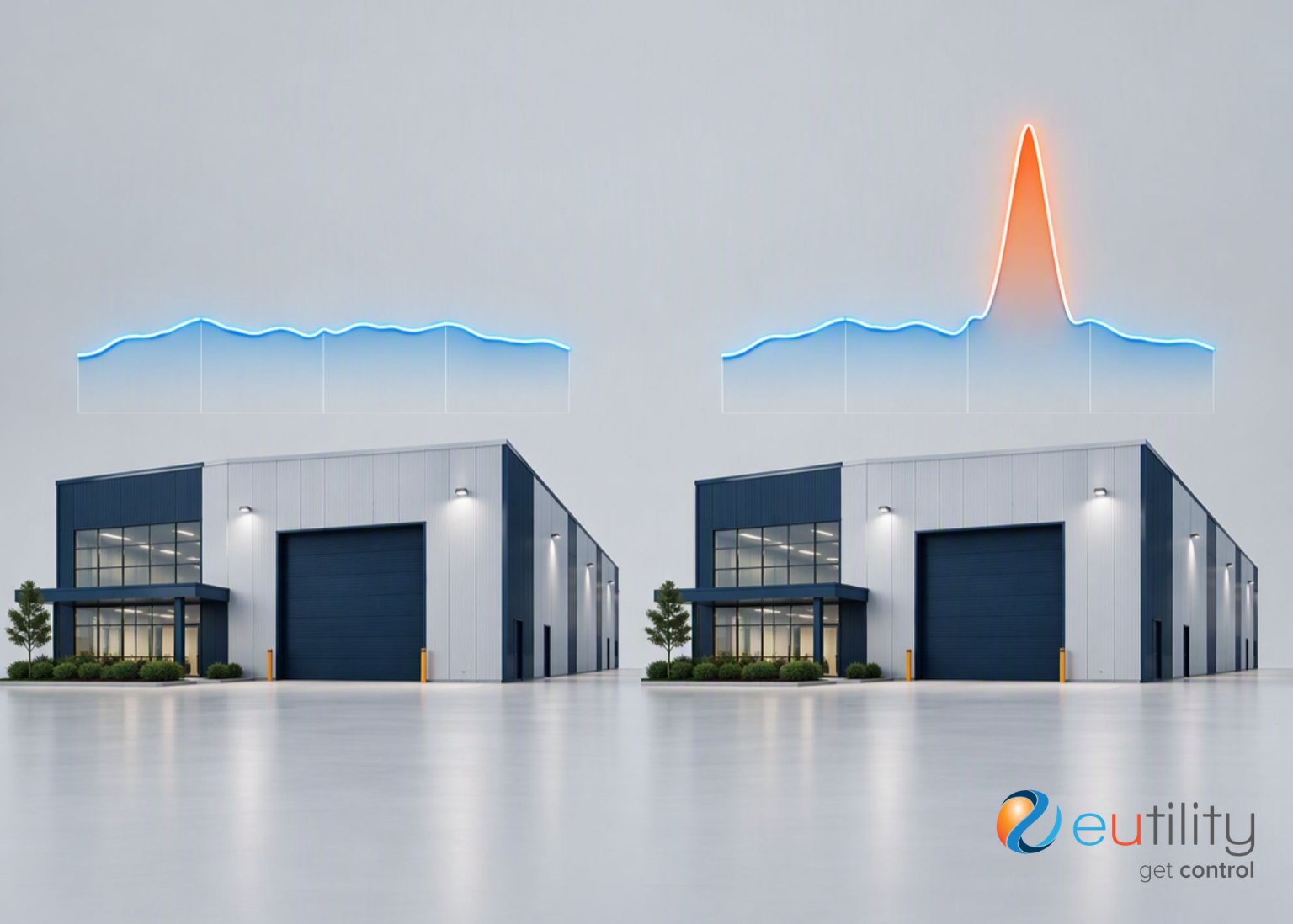
Is an old peak still setting your demand charges?
Eutility can trace the billed demand on each site back through at least 13 months of invoices and interval data, and ask the retailer and network to exclude a one-off spike or reset the demand. Email customerservice@eutility.com.au or call 1800 676 098.