Victorian businesses now eligible for new commercial and industrial solar incentives
Solar Victoria and the Victorian Energy Upgrades program are offering upfront incentives of up to $35,000 for 30–200 kW commercial solar systems installed after 29 September 2025.
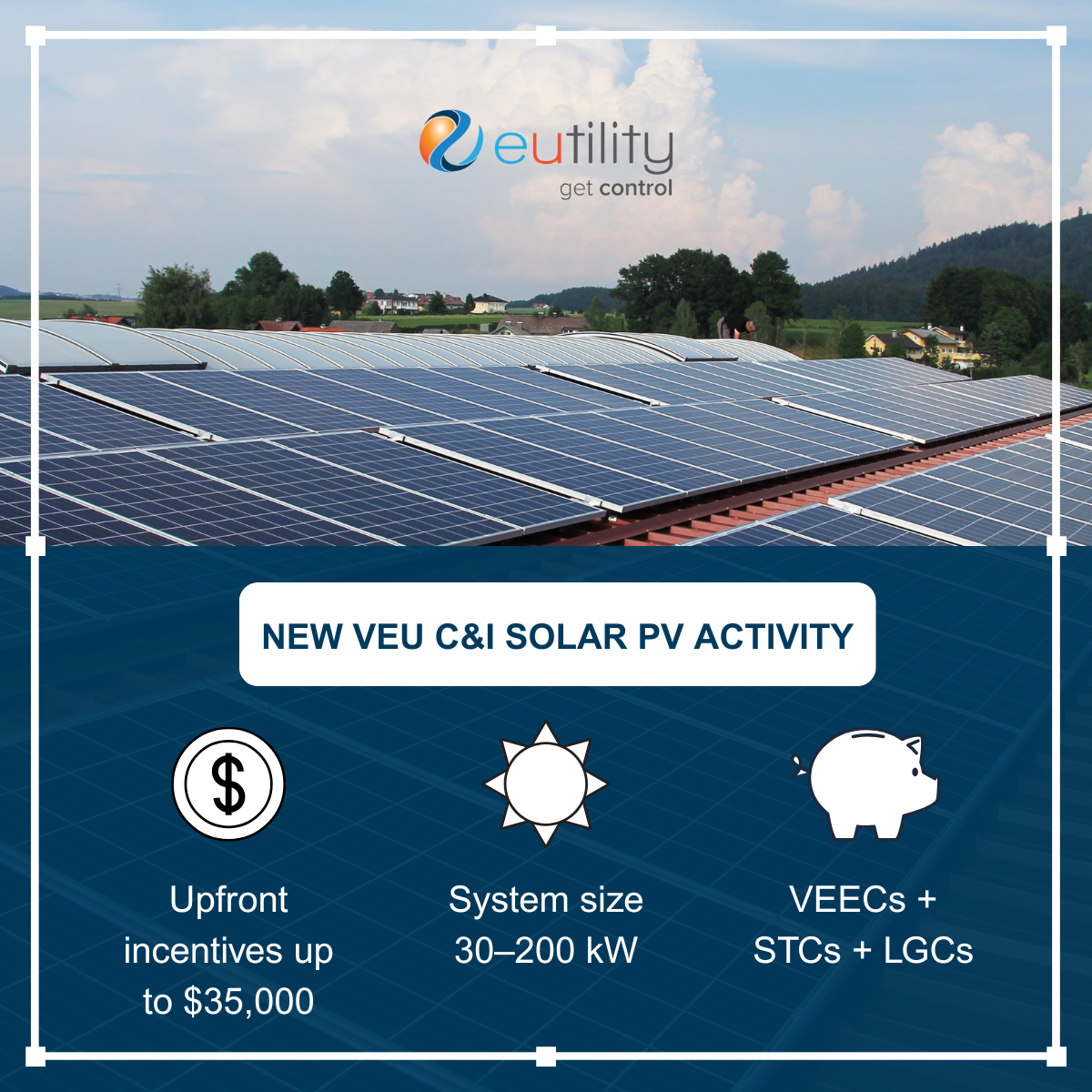
- A new Victorian Energy Upgrades activity offers up to $35,000 upfront for commercial and industrial solar systems.
- It applies to systems between 30 kW and 200 kW installed after 29 September 2025.
- VEECs can now be combined with STCs and LGCs, materially improving project returns.
- Eligibility and approved-hardware rules are specific, so confirm them before you commit to an installer.
Victorian businesses considering solar have a materially better case than they did a month ago. The Victorian Energy Upgrades (VEU) program and Solar Victoria have launched a new commercial and industrial (C&I) Solar PV activity, offering upfront incentives of up to $35,000 for systems between 30 kW and 200 kW installed after 29 September 2025.
For mid-sized sites such as manufacturing, cold storage, retail centres, aged care and warehousing, that band is exactly where most commercial rooftop projects land. An incentive of this size can shorten a payback period by a year or more, which is often the difference between a business case that gets signed and one that stays in the drawer.
What has actually changed
The new activity creates a dedicated pathway for C&I solar within the VEU framework, rather than leaving commercial systems to rely solely on federal certificates. In practice it means three things:
- An upfront incentive, not a deferred one. The benefit is delivered at the point of installation, reducing the capital you need to fund.
- A defined system size band. Systems from 30 kW to 200 kW are in scope: above household scale, but below utility scale.
- A hard start date. Only installations completed after 29 September 2025 qualify.
The part that changes the numbers: stacking certificates
The most commercially significant detail is that VEECs can now be combined with STCs and LGCs. Historically, businesses had to choose a single certificate pathway. Being able to layer them means a single project can draw on more than one incentive scheme at once.
| Certificate | Scheme | What it rewards |
|---|---|---|
| VEECs | Victorian Energy Upgrades (state) | The approved C&I solar installation itself, paid as an upfront incentive |
| STCs | Small-scale Renewable Energy Scheme (federal) | Deemed generation from eligible small-scale systems, claimed upfront |
| LGCs | Large-scale Renewable Energy Target (federal) | Actual generation over time, creating an ongoing revenue stream |
The right combination is not the same for every site. It depends on system size, your consumption profile, how much of the generation you self-consume versus export, and whether you want value delivered upfront or across the life of the asset. Getting that structure wrong is one of the more expensive mistakes we see in commercial solar.
Who should be looking at this
The incentive is worth investigating if your business:
- Operates a Victorian site with 30–200 kW of viable roof or ground-mount capacity
- Has a daytime-weighted load profile, so generation is self-consumed rather than exported at low value
- Is electrifying gas processes, fleet or heating, and needs more on-site generation to support it
- Has emissions-reduction or ESG commitments where Scope 2 reduction is being measured and reported
What to confirm before you sign anything
Incentive programs of this kind carry conditions that decide eligibility after the fact. Before committing to an installer:
- Verify your system size falls inside the 30–200 kW band as designed, not as originally scoped.
- Confirm the specified panels and inverters appear on the approved hardware list, because substitutions late in a project can void the incentive.
- Check that your installer is accredited to create VEECs under the activity.
- Confirm in writing how the incentive is passed through on your quote, and whether STCs are included or itemised separately.
- Model the project on your actual interval data, not a generic generation estimate.
The incentive is the easy part. Whether a commercial solar project delivers depends on sizing it to your real load and structuring the certificates correctly.
Where Eutility fits
We are independent of every installer and retailer, so our only interest is whether the project stacks up for you. We help clients confirm eligibility and hardware requirements, size systems against real consumption data rather than assumptions, structure the VEEC, STC and LGC position, and run a competitive process so quotes are compared on a like-for-like basis. Through SmartSolar we then monitor generation and performance after commissioning, so underperformance is caught early rather than discovered in a quarterly bill.
Solar rarely sits on its own. It interacts with your network tariff, your retail contract, your demand charges and your emissions reporting, which is why we look at it as part of a broader energy strategy rather than a standalone purchase.
Next steps
Eligibility and hardware requirements are set out in full on the Victorian Government’s site: New Victorian Energy Upgrades commercial and industrial solar activity.
To talk through how your sites could take advantage of the incentive, email us at customerservice@eutility.com.au or get in touch with our team.
Keep reading
Could your Victorian sites claim this incentive?
We confirm eligibility, size the system against your real consumption data and structure the VEEC, STC and LGC position, independent of every installer. Email customerservice@eutility.com.au.