You are billed for more energy than your meter records. Should you be?
Usually, yes, and the reason is legitimate. The question worth asking is whether it was calculated with this year's numbers.
- Loss factors add your share of network losses, so you usually pay for more energy than your meter records.
- Loss factors vary by network, voltage and location, and new values apply every 1 July, so bills and budgets should use this year's figures.
- Risks include last year's values after 1 July, the wrong connection class and bills not split at 1 July.
- Network charges use metered quantities, while loss factors flow into the retail energy charge and, depending on the contract, other volume-based charges.
Loss factors are multipliers that add a site's share of the electricity lost on the transmission and distribution networks to the energy it is billed for. The distribution loss factor (DLF) and marginal loss factor (MLF) are set for each financial year, and new values take effect on 1 July.
Pull the retail energy charge apart on a large electricity bill and you find something that looks like an error but is not. In most cases, you are being billed for slightly more energy than your meter recorded. Before you dispute it, it helps to understand why it is there.
Where does the extra energy on your bill come from?
The transmission network carries electricity from power stations over long distances via high voltage lines. The distribution network is the final stage of the journey, where substations and transformers reduce the voltage and the network branches out to deliver electricity to end consumers.
As electricity moves through the transmission and distribution networks, some of it is lost as heat in lines, cables and transformers. The Australian Energy Market Operator (AEMO) puts these losses at approximately 10% of the total electricity transported between power stations and market customers. That lost energy is real. It has to be generated, and someone has to pay for it. The market allocates that cost back to the users whose supply required it.
So how is each site's share worked out? Through loss factors. AEMO explains that network losses are represented as transmission and distribution loss factors, calculated and fixed annually. Two apply to most sites:
- Distribution loss factor (DLF). This describes the average losses on the distribution network between your site's connection point and the transmission network. Each distribution network determines its DLFs for the coming financial year, has them approved by the Australian Energy Regulator (AER), and gives them to AEMO to publish by 1 April. They apply from 1 July.
- Marginal loss factor (MLF), also called the transmission loss factor (TLF). It covers losses on the transmission network between your area's transmission connection point and the point in your region where the wholesale price is set. AEMO determines MLFs for transmission connection points for each financial year, and updates the list during the year as new connection points are added. AEMO's reports use MLF, while some retailers' bills use TLF. Some invoices, however, use TLF for a total loss factor that combines the transmission and distribution factors, so it is worth checking how your retailer defines it.
These are the rules in the National Electricity Market. Western Australia's Wholesale Electricity Market has its own loss factors, which AEMO also publishes.
How do loss factors reach your bill?
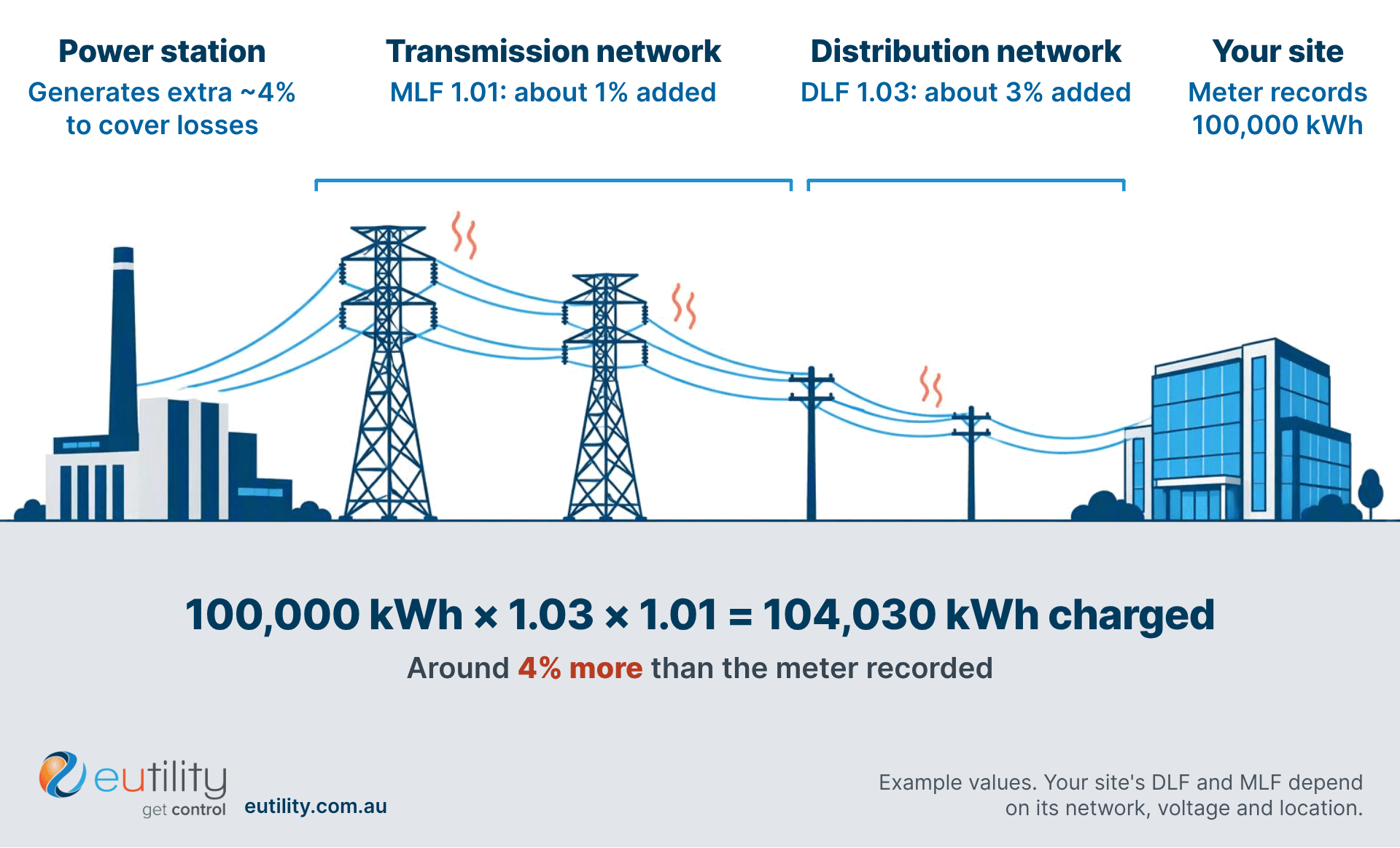
Each factor works as a multiplier on the energy your meter records. A combined factor of 1.04, for example, means you pay for about 4% more energy than your meter recorded, to cover your share of the energy lost across the transmission and distribution networks. For almost every site, the combined factor is above 1. In rare cases, a site close to large generation or interconnector imports can have an MLF low enough to bring it below 1.
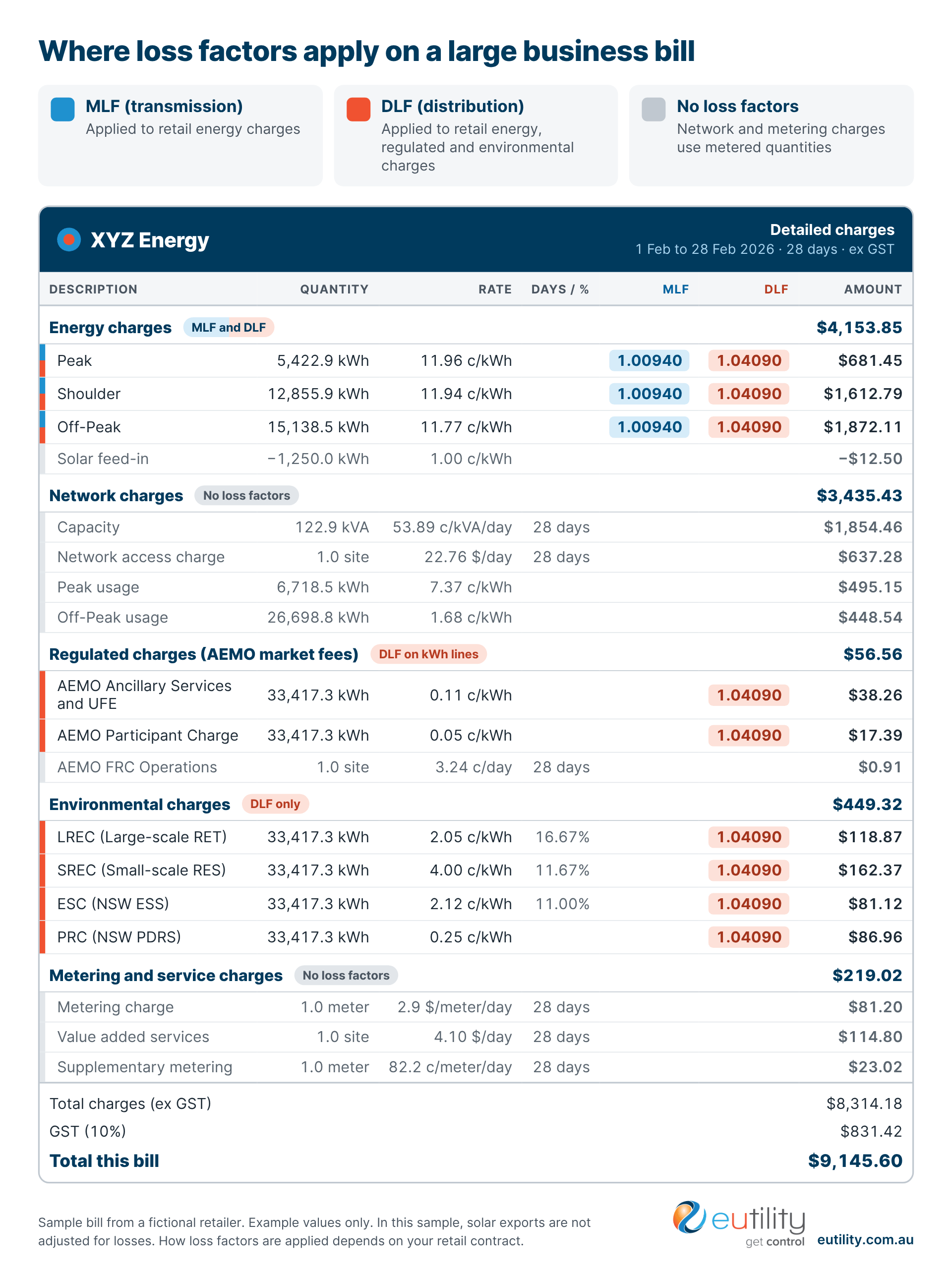
Loss factors affect the volume of energy accounted for in wholesale market settlement and are reflected in the retailer's cost of supplying the site. Retail contracts commonly pass this effect through by applying the relevant loss factors to metered consumption or the contracted energy rate. Either way, the effect on your bill is the same. On small business plans, the cost of losses is usually built into the rate per kilowatt-hour instead, so the checks below apply to large business contracts only.
How much do loss factors vary?
Are the amounts large enough to matter? They are meaningful, and they move every year. Ausgrid's Distribution Loss Factor Calculation Methodology Paper (March 2026) shows losses across its distribution network reconciling to 3.19% for 2024-25, and forecasts 3.28% for 2026-27. Losses are higher further down the network, at lower voltages. AEMO's 2026-27 Distribution Loss Factors include the following examples for business customers, although the applicable factor depends on the customer's tariff class, voltage level, network location and connection arrangement:
- Ausgrid: 1.0398 on its low voltage business tariffs, 1.0128 at high voltage and 1.0053 at sub-transmission.
- Energex: 1.0503 for a site on a low voltage line, against 1.0189 on an 11 kV line.
- Powercor: up to 1.0970 for a site on a low voltage line in areas supplied by long sub-transmission lines.
- Ergon Energy: 1.0742 on a low voltage line in its eastern area and 1.2049 in its western area. A DLF of 1.2049 means that, for settlement purposes, the metered energy is multiplied by approximately 1.2049, producing an uplift of about 20.49% before the relevant transmission loss factor is applied.
- SA Power Networks: 1.1001 for large low voltage business customers, up from 1.0620 in 2025-26.
- Endeavour Energy: 1.0489 for sites supplied from a distribution substation, down from 1.0577.
Sites with large loads can be given a site-specific DLF of their own instead of the network average, which is also recalculated every year. In the National Electricity Market, site-specific DLFs are generally required for large customers with demand above 10 MW or annual consumption above 40 GWh. Western Australia's Wholesale Electricity Market operates under a separate loss-factor framework. Western Power's 2026-27 methodology, for example, differentiates connection arrangements using contracted maximum demand thresholds, including 1,000 kVA and 7,000 kVA, together with factors such as the site's distance from the relevant substation.
MLFs can also change significantly from year to year. Unlike DLFs, which represent average losses on a distribution network, MLFs represent marginal losses on the transmission network. AEMO calculates them from half-hourly forecasts of generation, demand, interconnector flows, network configuration, generating unit availability and other power-system assumptions, then volume-weights the results into an annual MLF for each connection point.
This means an MLF is not simply a function of a site's distance from the point in its region where the wholesale price is set. It moves when the direction and volume of flows on the transmission network change, whether from new renewable generation, batteries, transmission upgrades, power-station retirements, outages, changing demand, interconnector flows or seasonal and daily patterns of power flow.
The 2026-27 figures illustrate this clearly:
- At Chapel Street in Hobart, the MLF increased from 1.0086 in 2025-26 to 1.0334 in 2026-27. AEMO attributes the broader rise in Tasmanian MLFs primarily to increased imports from the mainland via Basslink.
- At Berri in South Australia's Riverland, the MLF fell sharply from 1.0493 to 0.8921, part of an average 6.93% fall in Riverland load MLFs that AEMO links mainly to increased imports via Murraylink, which materially changed transmission flows through the Riverland.
For load, an MLF below 1 tends to be advantageous, because additional load there reduces marginal losses under the prevailing direction of transmission flows. An MLF above 1 means additional load adds to them.
Importantly, these factors are annual forward-looking values, not permanent characteristics of a site. That matters for budgets as well as bills: a forecast of next year's electricity costs should use the new DLF and MLF for each site rather than rolling this year's values forward, or it will be out by however much they change. DLFs may change because of changes in distribution-network losses and customer classifications, while MLFs can move substantially as generation, storage, demand, transmission infrastructure and interconnector flows change across the National Electricity Market.
What can go wrong each 1 July?
If the charge is legitimate, the risk is in the annual reset. New DLFs and MLFs take effect every 1 July, and each one has to reach the billing system correctly. Things that can go wrong include:
- Last year's values are still being applied after 1 July.
- The new values are switched over on the wrong date, or a bill that spans 1 July is not split at that date.
- The site is billed on the wrong connection class, such as a low voltage DLF for a high voltage site. On Ausgrid's network, that alone would bill a high voltage site for about 2.7% more energy than it should.
- A site large enough for a site-specific DLF is billed on the network average, or the MLF used is for the wrong transmission connection point.
- The factor is applied in a way the contract does not provide for, for example to a rate that already includes losses.
Because the adjustment often sits inside the energy quantity or rate rather than on its own line, it is one of the least visible errors on the bill. A difference of under 1% repeats on every kilowatt-hour, every month. For a site spending $500,000 a year on retail energy charges, a DLF that should have fallen by 0.8%, as Endeavour Energy's distribution substation factor did for 2026-27, is worth about $4,200 a year if it is not updated.
Which charges do loss factors not affect?
Your network charges are one place a loss factor error will not show up. Network tariffs are charged on the energy and demand your meter records. Energex's 2026-27 Network Tariff Guide puts it plainly: network charges are calculated on the metered quantities and are not subject to DLF. Loss factors flow into the retail energy charge and, depending on the contract, into other retail charges priced on energy volume, such as environmental scheme charges and regulated market charges, which are often adjusted by the DLF alone. Knowing that boundary saves you looking for a loss factor error in the wrong part of the bill.
Not every loss is captured by a loss factor. The Australian Energy Market Commission (AEMC) describes unaccounted for energy (UFE) as including technical losses that loss factors do not capture, estimation errors and commercial losses such as electricity theft. Some retailers may pass UFE costs through as a separate charge. UFE is separate from DLFs and MLFs and is therefore not covered by the loss-factor checks below.
How can you check the loss factors on your bills?
The verification question is narrow and answerable. For each site, ask:
- Are the correct loss factors being used? Confirm the DLF matches the site's connection class and voltage, or its site-specific DLF where applicable, and that the correct MLF applies to its transmission connection point.
- Are the loss factors for the current financial year? New annual factors generally apply from 1 July, so invoices spanning 1 July should apply the appropriate factor to each period.
- Are the factors applied correctly? Check that the DLF and MLF are combined and applied in accordance with the electricity contract and billing methodology.
The codes are on record. Your site's NMI standing data in the market system holds its DLF code and its TNI code, which identifies its transmission connection point, and your retailer or network can confirm them. AEMO's published tables then give the value for each code. Without those checks, you are trusting that values which change every year were updated correctly. The bill may show the factor, but not whether it is the right one.
Are this year's loss factors on your bills?
If you are not sure which loss factors your sites are billed on, or whether this year's values were applied from 1 July, Eutility can help.
For sites on our invoice validation service, SmartValidation, checking loss factors is part of the automated validation of every invoice. When a site is added, we load its contracted rates and assign its DLF and MLF codes from a tariff database we update every financial year. As each invoice arrives, SmartValidation rebuilds it from your interval data, your contracted rates and the loss factors that apply that year, then compares it with the retailer's bill line by line. If the two do not match, the invoice is flagged for our team to review. Once we confirm a discrepancy, we raise it with the retailer as a logged case and follow it up until it is corrected, then verify the adjustment and report the saving back to you.
If your sites are not yet on SmartValidation, the Eutility team can talk you through how it would check your loss factors, along with the rest of your bill.
Call 1800 676 098 or email customerservice@eutility.com.au.
Sources
- Australian Energy Market Operator, Loss factors and regional boundaries (accessed October 2026).
- Australian Energy Market Operator, Distribution Loss Factors for the 2026-27 Financial Year, April 2026, on AEMO's Loss factors and regional boundaries page under Current reports, 2026-27 Financial year (accessed October 2026).
- Australian Energy Market Operator, Marginal Loss Factors: Financial Year 2026-27, October 2026 (accessed October 2026).
- Australian Energy Market Operator, Loss factors (Wholesale Electricity Market) (accessed October 2026).
- Western Power, 2026/27 Loss Factor Report, May 2026 (accessed October 2026).
- Australian Energy Market Operator, NMI discovery, MSATS user guide (accessed October 2026).
- Ausgrid, Distribution Loss Factor Calculation Methodology Paper, March 2026 (accessed October 2026).
- Endeavour Energy, Distribution Loss Factors 2025-2026 Financial Year: Final Report (Public Report), February 2025 (accessed November 2026).
- Energex, Network Tariff Guide 2026-27 (accessed October 2026).
- Alinta Energy, Understand your bill (large business) (accessed October 2026).
- AGL, Electricity invoice explainer (business, CL1680), June 2026 (accessed November 2026).
- EnergyAustralia, What you need to know about your electricity bill (large business) (accessed October 2026).
- Australian Energy Market Commission, Global settlement and market reconciliation (accessed October 2026).
Keep reading

Want every invoice checked against this year's loss factors?
Eutility's invoice validation service, SmartValidation, rebuilds every invoice with the loss factors that apply that year and raises any difference with your retailer. Email customerservice@eutility.com.au or call 1800 676 098.