Progressive purchasing and selling: managing energy price risk step by step
Progressive purchasing and selling spreads energy buying or selling decisions over time, so less of your result rides on a single day's price. Here is how it works, the decisions behind it and who it suits.
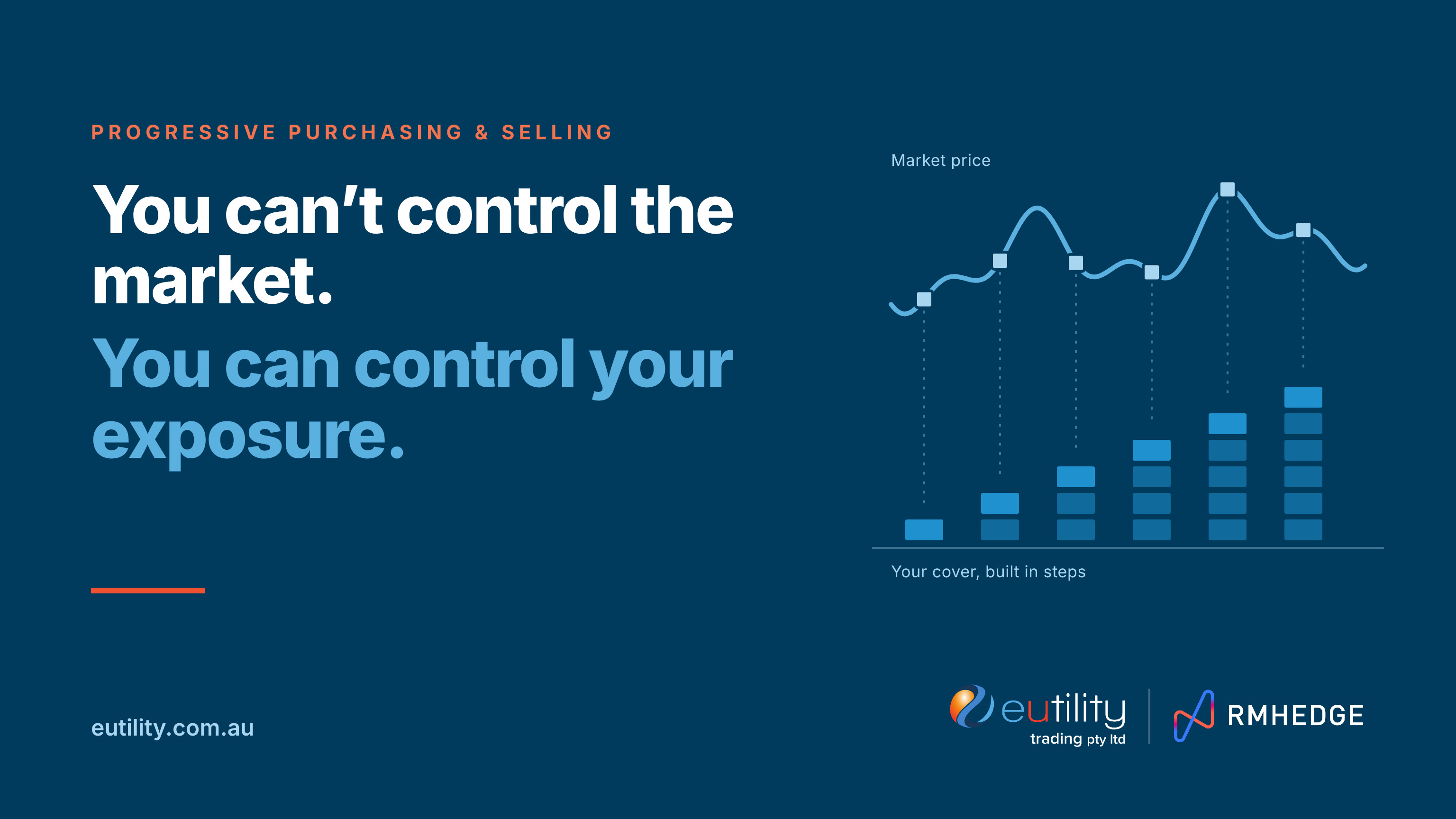
- Pricing a whole energy requirement on one day ties your result to that day's market.
- Progressive purchasing spreads decisions over a longer period, building your position step by step.
- Each step answers three questions: when to act, how much to cover and how far ahead.
- It typically suits users of more than 20 GWh of electricity or 300 TJ of gas a year.
Progressive purchasing and selling is a way to buy or sell energy and other commodities in steps over a longer period, instead of committing your whole requirement at once. You build your position as market conditions change, so less of your result rides on any single day in the market.
It is the approach behind Eutility's wholesale energy trading and risk management service, SmartTrading, which we deliver with our partner RMHEDGE. This article explains why timing risk matters, how a progressive strategy works and how to tell whether it suits your business.
What is the risk in buying or selling all at once?
Locking in a large share of your requirement in one go gives you price certainty. The catch is that your result depends heavily on where the market sits on that one day. The market keeps moving after you buy or sell, and the gap between your locked price and where the market goes is your timing risk.
No one can reliably pick the perfect day to go to market. Retailer pricing is also typically valid for only 2 to 7 days, so once offers arrive, a single large decision has to be made quickly.
How does progressive purchasing and selling work?
A progressive strategy spreads your buying or selling decisions over a longer period. You build your position step by step as market conditions change, with each step covering a share of your requirement, instead of committing your entire requirement at once. Your result is an average cost, or for a seller an average revenue, across those steps.
The aim is to reduce how much rides on any single point in time. It doesn't rely on predicting the market. Market risk remains, but you manage it with a clear structure.
A progressive approach can help your business:
- spread your timing risk
- respond as market conditions change
- match your buying or selling to your risk appetite
- avoid making one large decision on a single day.
What decisions shape a progressive strategy?
Every buying or selling decision comes down to three questions:
| Decision | The question |
|---|---|
| When? | Is the market attractive enough to act on today? |
| How much? | What share of your requirement should you buy or sell? |
| How far ahead? | Are you covering the next quarter, the next year or several years? |
The right answers depend on your business's risk appetite and objectives. Working through them at each step gives you a framework for making better, more disciplined decisions as prices move.
What does it take to do progressive purchasing well?
Progressive purchasing and selling takes more than splitting one purchase or sale into several. A strong strategy brings together five things:
- Risk management: a clear framework for how much risk is acceptable.
- Market intelligence: knowing what is driving the market.
- Analytics: data that informs every decision.
- Experience and execution: turning market insight into disciplined action.
- Governance and systems: making sure every decision is controlled, monitored and carried out effectively.
Is progressive purchasing right for your business?
No single procurement or sales strategy suits every business. The right approach depends on your exposure (how much commodity price risk your business carries), your risk appetite (how much market movement it can absorb), your objectives (price certainty, budget control or flexibility) and your resources (whether you have the expertise, systems and governance to run the strategy).
Progressive purchasing can be especially valuable for businesses with significant, ongoing commodity exposure. As a rule of thumb, it typically benefits users consuming more than 20 GWh of electricity or 300 TJ of gas a year. For electricity and gas contracts, our energy procurement service, SmartProcure, runs structured, competitive tenders.
Large gas users weighing up contract timing may also find our article on the gas reservation scheme useful.
How can Eutility help?
Eutility's wholesale energy trading and risk management service, SmartTrading, delivers progressive purchasing and selling with our partner RMHEDGE, under Eutility's Australian Financial Services Licence (AFSL 480703). It covers electricity, natural gas, Brent crude oil, JKM (the Asian benchmark price for liquefied natural gas), diesel, and mandatory and voluntary carbon markets.
SmartTrading agreements are contracted through energy retailers at transparent market prices, so they are not treated as derivatives and don't trigger special accounting disclosure. The strategy is built for risk management, never speculation.
If you'd like to understand whether a progressive strategy suits your business, the Eutility team can talk it through with you. Call 1800 676 098 or email customerservice@eutility.com.au.
Sources
- S&P Global, Platts JKM: Japan Korea Marker gas price explained (accessed November 2026).
Frequently asked questions
Keep reading

Is one buying date carrying too much of your energy budget?
Through SmartTrading, Eutility partners with RMHEDGE to bring the right people, expertise and market insight together to help you make confident decisions about risk. Email customerservice@eutility.com.au or call 1800 676 098.