Understanding the charges on your C&I electricity bill
What each type of charge on a commercial and industrial electricity bill means, from energy and network charges to regulated, environmental and metering costs, with a sample bill and a five-page guide.
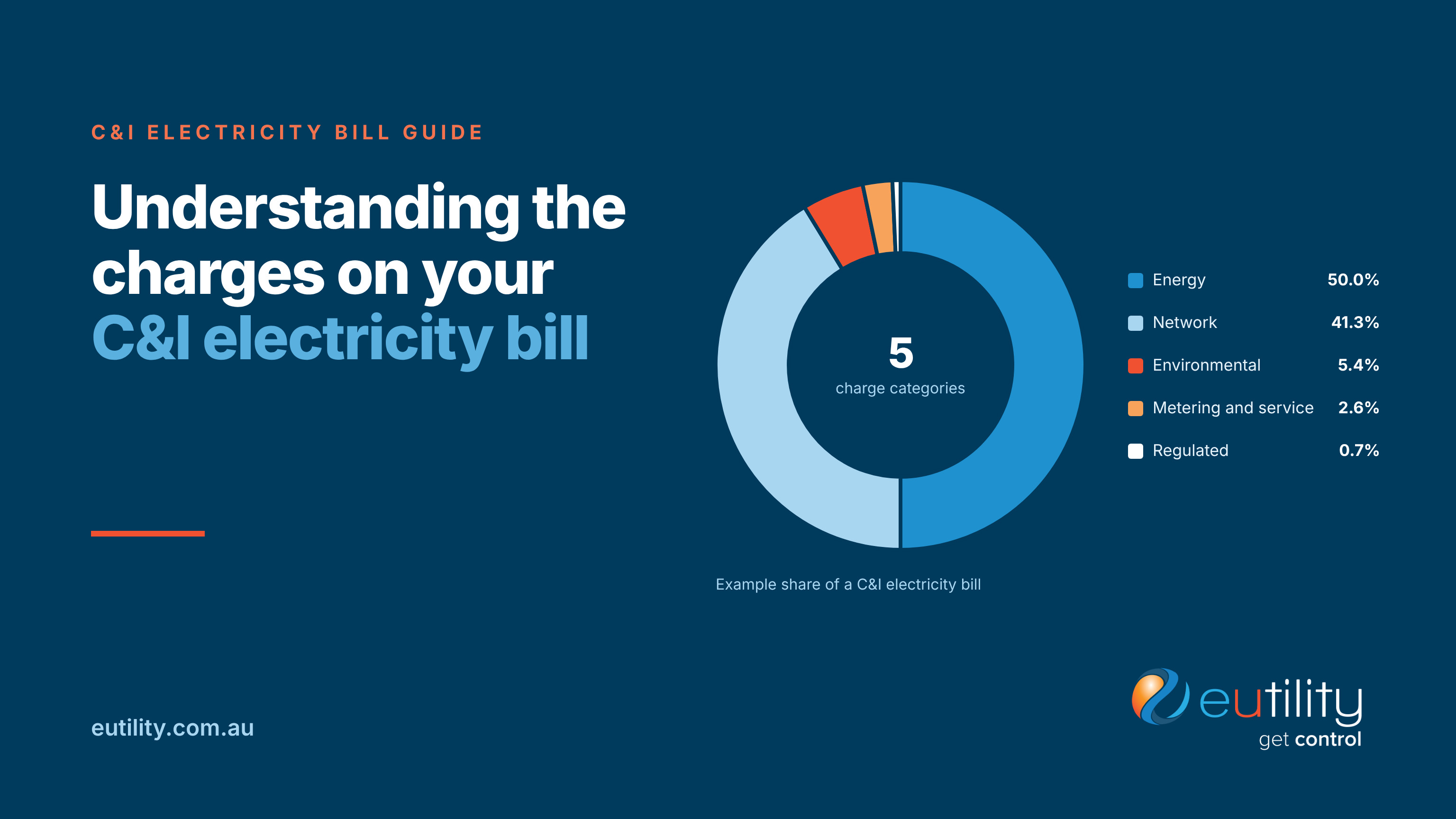
- A C&I bill typically has five charge types: energy, network, regulated, environmental, and metering and service.
- Energy and network charges together typically make up around 90% of the total bill.
- Network charges are typically around 40 to 50% of a C&I site's bill.
- Loss factors (MLF and DLF) slightly increase billable energy to reflect real-world electricity losses.
A commercial and industrial (C&I) electricity bill is typically made up of five types of charge: energy, network, regulated, environmental, and metering and service charges. Energy and network charges are typically the biggest drivers, together accounting for around 90% of the total bill.
Each type of charge is set by different parties and calculated in different ways. Knowing what each line represents is the first step to identifying where you may be paying more than you should.
What makes up a typical C&I electricity bill?
A C&I electricity bill is typically made up of five main charge categories:
- Energy charges: the cost of the electricity consumed.
- Network charges: the cost of transporting electricity to the site through the poles and wires network.
- Regulated charges: market and system operation charges.
- Environmental charges: charges related to government renewable and energy-efficiency schemes.
- Metering and service charges: charges related to metering services and supporting bill calculation.
While every site is different, this example gives a useful indication of how costs are generally distributed across a C&I electricity bill:
| Charge category | Share of bill |
|---|---|
| Energy charges | 50.0% |
| Network charges | 41.3% |
| Environmental charges | 5.4% |
| Metering charges | 2.6% |
| Regulated charges | 0.7% |
In most cases, the majority of electricity costs are driven by energy consumption and network demand.
What are energy charges?
Energy charges are the cost of the electricity consumed. This is the portion retailers procure from the wholesale market on behalf of the customer.
Usage is commonly split into time-of-use periods such as peak, shoulder and off-peak, with each period charged at a different rate. The applicable time bands can vary depending on the retailer and the site's location.
Two loss factors may also be applied. The marginal loss factor (MLF) accounts for transmission losses, and the distribution loss factor (DLF) accounts for losses within the local distribution network. These adjustments slightly increase the billable energy and cost to reflect real-world electricity losses.
What are network charges?
Network charges are the costs of transporting electricity to the site through the local poles and wires network. They help recover the cost of maintaining and operating the network infrastructure, and may include:
- Demand or capacity charges: based on the site's peak demand over a 15 or 30-minute interval.
- Usage charges: based on the amount of electricity transported through the network.
- Fixed charges: a daily charge for being connected to the network.
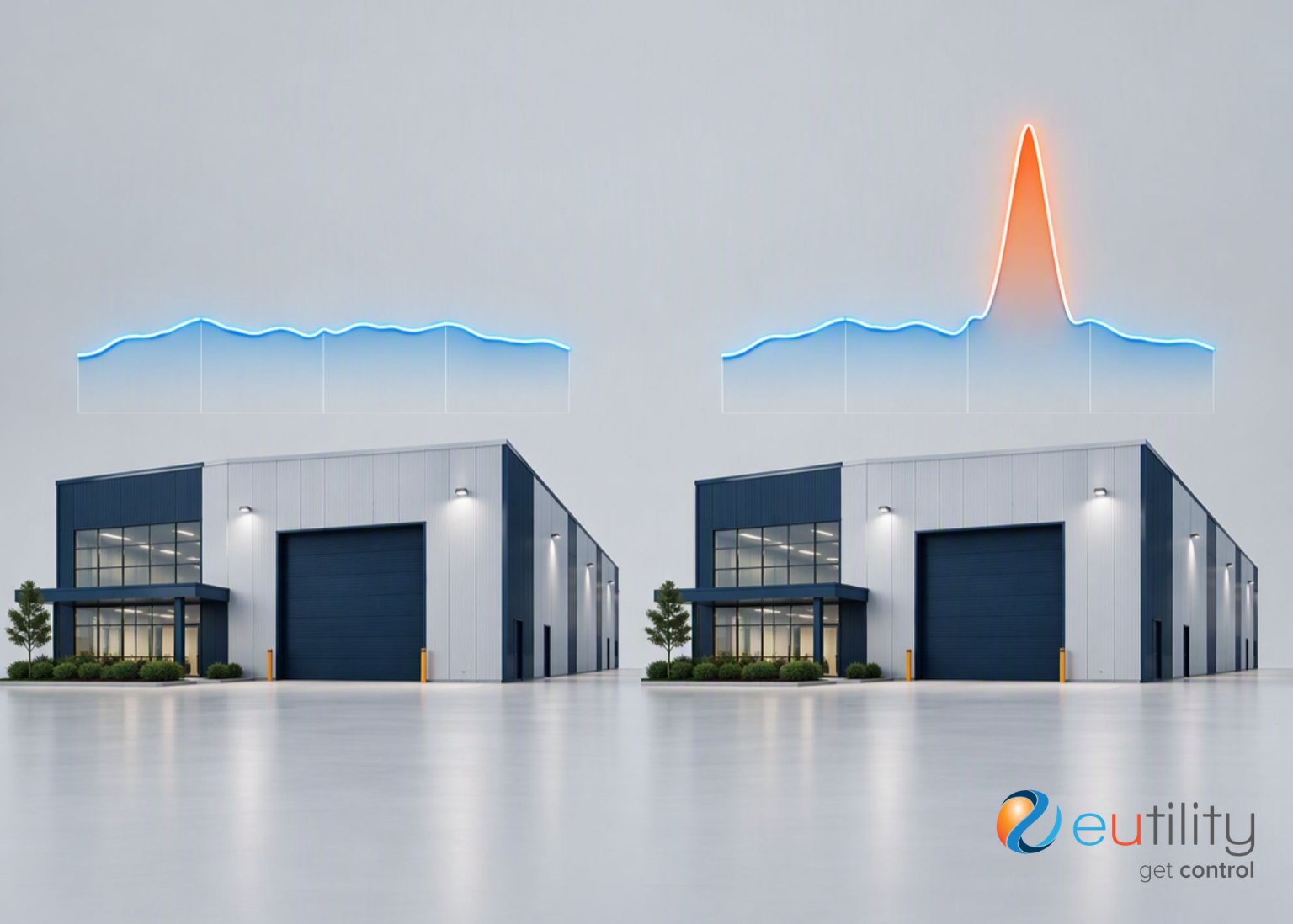
For many C&I sites, network charges are a significant component of the bill, typically around 40 to 50% of the total cost. Our Invoice Verification Series explains how demand charges are calculated and how one spike can set 12 months of rolling demand charges.
What are regulated charges?
Regulated charges are market and system operation fees that support the functioning of the electricity market. They are generally small compared with energy and network costs, but they are still an essential part of the overall bill. Typical examples include ancillary services, participant charges and market administration charges.
What are environmental charges?
Environmental charges fund government schemes designed to support renewable energy and energy-efficiency initiatives. They are generally applied to the total volume of electricity consumed, and some retailers also show the scheme percentage used in the calculation. Common labels include:
- LREC (Large-scale Renewable Energy Certificates): supports large-scale renewable electricity generation under the Renewable Energy Target.
- SREC (Small-scale Renewable Energy Certificates): supports eligible small-scale renewable energy systems under the Small-scale Renewable Energy Scheme.
State-based schemes may also appear, including:
- ESC (Energy Savings Certificates) and PRC (Peak Reduction Certificates) in New South Wales, which support the Energy Savings Scheme and Peak Demand Reduction Scheme.
- VEEC (Victorian Energy Efficiency Certificate) in Victoria, which supports the Victorian Energy Upgrades program.
- REPS (Retailer Energy Productivity Scheme) in South Australia.
What are metering and service charges?
Metering and service charges cover the services required to measure electricity use and support bill calculation. Depending on the retailer, meter type and contract, they may include the cost of the meter itself, meter data services and other metering-related items. Typical line items include a metering charge, value added services and supplementary metering.
These charges are often fixed, daily, monthly or charged per meter, rather than being directly linked to the amount of electricity consumed. The labels and structure can vary between retailers and sites.
What does an example C&I electricity bill look like?
The guide includes a sample C&I bill for a 28-day period, with every line item, quantity, rate and loss factor shown on page 3. The totals for each charge category are:
| Charge category | Sub-total (ex GST) | GST | Total |
|---|---|---|---|
| Energy charges | $4,165.68 | $416.58 | $4,582.26 |
| Network charges | $3,435.32 | $343.52 | $3,778.84 |
| Regulated charges | $56.46 | $5.64 | $62.10 |
| Environmental charges | $449.86 | $45.00 | $494.86 |
| Metering and service charges | $218.48 | $21.85 | $240.33 |
Where are the biggest opportunities to manage costs?
The biggest drivers of a C&I electricity bill are typically energy charges and network charges, which together account for around 90% of the total bill. This means the most effective opportunities to manage costs often come from:
- managing when and how electricity is used
- reducing peak demand
- reviewing whether the site is on the most suitable network tariff.
How can Eutility help?
Eutility's invoice validation service, SmartValidation, rebuilds each invoice from meter data and contracted rates and compares it with the retailer's bill line by line, so discrepancies can be raised with the retailer and resolved.
For SmartEnergy clients, Eutility undertakes an annual Network Tariff Review to assess the impact of published tariff changes and identify where alternative tariff options may be beneficial. On energy charges, Eutility helps clients secure competitive electricity pricing through informed procurement, with our energy procurement service, SmartProcure, and ongoing bill review.
Call 1800 676 098 or email customerservice@eutility.com.au.
Frequently asked questions
Keep reading
Not sure every charge on your bill is correct?
SmartValidation checks each invoice line against your contracted rates, network tariff and meter data, and recovers what has been overcharged. Email customerservice@eutility.com.au to have your bills reviewed.